
Now, Voyager
The fourth Star Trek series never found its reason to be

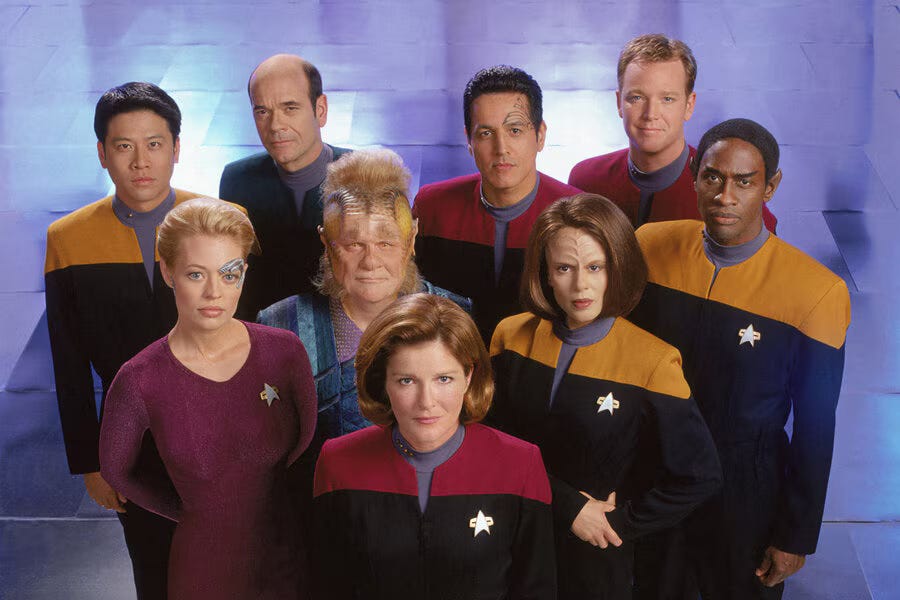
The warning signs, for ship-based Star Trek, were there. The final season of Star Trek: The Next Generation, run by Jeri Taylor – Voyager’s mother, had been a dud. Star Trek’s creative energy had vented from the Enterprise’s nacelles and been collected on Deep Space Nine, where it was been utilised for new purposes. The prospect of a different setting, new character dynamics, and the promise of serialisation laid the foundations for the Star Trek universe to mature and deepen. Meanwhile, on the Enterprise, high-concept gazumped character development, the show’s rich stockpile of unresolved plot and character threads was manifestly unpulled, and it all ended with a show based on technobabble (on a human level nothing lives longer in the memory than an anti-time anomaly). Yes, the tired producers of Next Generation had wasted its final voyage, and these were the space folk now charged with inventing yet another ship-based Trek.
Perhaps it was inevitable, then, that Voyager would be half-baked and undercooked – a show that looks intellectually spry and playful in the Alex Kurtzman era of deadening stupidity, but is nevertheless deeply flawed. On its original run, I used to call it “Star Trek Light”, on account of its weightlessness, and characters that failed, until the arrival of Jeri Ryan’s breasts, to fully engage the senses and poke at the intellect. Voyager was an easy watch, a comfort blanket adorned with pictures of swirling galaxies and child-friendly aliens, but it felt uninspired – a show ordered to replace a better show, which the intrepid writers and producers rushed into being, then spent years retrospectively fortifying to create the illusion of solidity and coherence.
The problems with the show have been well documented, particularly by Ronald D. Moore, the Star Trek writer who joined the staff very briefly (he sired two teleplays) before leaving ignominiously, repelled by the listlessness and chaos of a series with no structuring philosophy or narrative. Moore tells us that the problem with Voyager is that it is “a show about nothing”—formless, undirected exploration. A show as breezy as Jerry Goldsmith’s theme.
Dr Moore’s diagnosis is correct; Voyager was fun but frivolous, a show untroubled by big ideas. At conventions, the cast are terrific fun – a company you’d want to work with, provided you weren’t Jeri Ryan suffering Kate Mulgrew’s jealously, but one senses this lightness of being reflects the Voyager’s crew self-awareness when it comes to their own redundancy. Everyone likes Star Trek: Voyager, the way you love that buffoon in your social circle who makes everyone else feel substantial and shrewd, but nobody really respects it. Voyager’s not the show you go to when your relationship breaks up, or your cat dies. Voyager’s the show you cue up on Pizza night, with “Threshold” the episode reserved for those occasions when you inject heroin into the thick vein in your Tom Paris.
The initial challenge for the writers was to find a way to make Voyager distinctive from The Next Generation. They could have set it further in the future—perhaps a century ahead—to re-imagine the Federation itself. But that was never really on the cards. By 1995, the Star Trek universe as depicted in The Next Generation and Deep Space Nine had become so richly detailed, so concrete, that it had become synonymous with the franchise itself. It was not yet an albatross around the writers’ neck. It took seven seasons of Voyager to make Brannon Braga wary of the twenty-four century. Every tale of exploration that could be told had been told, not to mention a few – “Darkling”, “Learning Curve”, “The Q and the Grey”, that should never have been told.
With hindsight, boldly going further into the future would have been the smart point of differentiation. It would have allowed Deep Space Nine to retain the mantle of the “present-day” Star Trek series, while Voyager could have offered a glimpse of the far-flung future. One can only imagine what an intelligent team of writers, working in tandem across two different shows, might have accomplished with such a dual format—seeding ideas in Deep Space Nine that Voyager could pick up a century later. Alternatively, Voyager could have existed in a hermetically sealed world, alluding occasionally to the Star Trek that came before, but fundamentally standing on its own. This might have given it its own character, not to mention a fully developed backdrop.
Instead, the chosen premise was a setup built to facilitate a threadbare concept: that Voyager would be a lost ship, populated by a split crew. The Maquis, a group of breakaway anti-Cardassian freedom fighters (or terrorists), were created on Deep Space Nine to serve this purpose. Voyager would be a Starfleet vessel marooned in the unexplored Delta Quadrant with these tiresome, un-Rodenberryian renegades. They would be forced to cooperate with the Starfleet crew to survive, and consequently, unlike the Enterprise-D, Voyager would be a ship of tension and moral compromise, simultaneously facing the dangers of unknown space, resource deprivation, and being non-aligned in a region of space with its own established imperiums.
Had Voyager truly been that show, it might have been very interesting indeed, even the best of them all —perhaps not immediately popular with Next Generation fans, who would have preferred a weighty and creatively revitalised Season 8, but a bold and compelling journey into the unknown; a serialized odyssey still admired today. Unfortunately, the writers did not have the courage of their convictions. They killed their own premise in “Caretaker,” the pilot episode, at the conclusion of which Chakotay, B’Elanna Torres, and the other members of the Maquis adopt Starfleet uniforms, respect the ship’s chain of command, and conveniently fill positions vacated by those killed during the transfer to the Delta Quadrant.
This launchpad, while pleasing and reassuring for TNG fans, prompted a million heads to be scratched: what was the point of the schism? Why have two crews if they function as one? Surely Voyager wasn’t just going to pay lip service to a split-crew dynamic. Yet apart from the occasional episode—such as “Worst Case Scenario,” in which those tensions are explored safely—the divergence was never meaningfully revisited. The writers didn’t want to write it, and the studio didn’t want to see it, begging the question – why conceive it in the first place?
This mattered because there was little external threat either. One might have forgiven the writers if Voyager, upon arriving in the Delta Quadrant, had been besieged by terrifying new alien empires to rival anything from the Alpha or Gamma Quadrants. Perhaps this would have been a crew too busy surviving to quarrel internally, a crew forever on the run, forced to question every value they held in service to gory pragmatism. But Voyager’s scribes didn’t have the stomach for Seven Years of Hell; they appeared to want only to continue writing sub-Next Generation-style episodes with an inferior crew.
In Season 1, Voyager’s primary enemies were the Kazon—rightly condemned by fans as mail order Klingons. The Kazon were dull, backward, and unmenacing —fended off by a single Starfleet vessel for two years. In the two-part “Basics” they finally grabbed the boat, only to be defeated by a psychotic betazoid and a hologram. Were we really meant to be intimidated by a race that could not pirate one ship? It might have been a different matter had Voyager faced something like the Galactic Empire— an advanced, powerful military force, but no thought had been given to the political makeup of the Delta Quadrant—no sense of who lived there, or what power structures existed was apparent from the outset. If only someone in the writers’ room had thought to draw a map and populate it – the seasons might have written themselves.
Voyager apologists will tell you the show improved at the end of its third season when the Borg loomed, along with bigger fish like Species 8472. But the introduction of the networked nanoprobe injectors was an implicit admission that the series had failed to produce an original or striking adversary of its own, to rival the Klingons, Romulans, Cardassians, or even the Ferengi. Nothing symbolised the insipid nature of Voyager’s first three seasons more than Season 4’s introduction of Seven of Nine, a former Borg drone who became a classic Star Trek outsider.
Kate Mulgrew, who played Captain Janeway, was notoriously incensed by the introduction of Jeri Ryan’s character. As she tells it, this was “dumbing down”—a capitulation to the base instincts of a largely male audience, bringing in a beautiful young woman with perfect breasts and a skin-tight costume to wake up bored viewers. But Seven was a correction not a capitulation – a much-needed infusion of life. Once on board, it was impossible to imagine the bridge without her.
The truth is that Voyager’s original characters, as hastily conceived, were, frankly, dull. Janeway was strong but boorishly maternal, lacking Patrick Stewart’s gravitas or William Shatner’s rakish charm. Tuvok was a lesser Spock – intellectual but edgeless. Harry Kim had no more life than the station he monotonously manned. Tom Paris, the disgraced cadet and born rule-breaker, subsequently decided to be obedient and low-key. B’Elanna Torres, ostensibly defined by her half-Klingon heritage, amounted to little more than a bad-tempered bore. Chakotay, a renegade lest we forget, instantly became Janeway’s dutiful and dewy-eyed first officer – a spiritual dud that defeated the writers hired to suffuse him with personality. Neelix – a flamboyant Delta Quadrant native, was conceived as comic relief, but played without wit or edge by Ethan Phillips, became a trying irritant. The Doctor, at least, had a personality – waspish, irreverent – but his status as Starfleet hardware didn’t give Robert Picardo great latitude when it came to character development.
The least dynamic of all was Jennifer Lien’s Kes, a tag-along from the mayfly species, Ocampa, with a decade’s life expectancy. In theory, this could have been a fascinating character, someone who saw life very differently, on account of her dog years, with a philosophy and impatience to match. But, as played, Kes was wallpaper – a sweet but invisible ingenue, whose medical apprenticeship with the Doctor made little sense, given her limited life span. By the time she could be a qualified physician, she’d be ready to retire, but Janeway was content to waste her time to plug a skills gap. Behind the scenes, Lien was reportedly troubled and unreliable, and the writers, who had no idea what to do with the character, became intent on writing either her, or the equally dead-eyed Harry Kim, out. In the end, an article heralding Garrett Wang as a sex symbol, saved him and condemned Lien, creating a continuity headache ahead of the show’s best two-parter “Year of Hell”. Kes left Voyager, hurling her friends 10 years closer to home, and into the path of the time-altering Krenim, yet somehow, in the alternate timeline of Season 3’s “Before and After”, she’d been present in the story without the 9,500 light-year space jump. Audiences were left to lament that the woman who went wild in private – bearing her breasts to minors, driving under the influence, couldn’t even leave the show right.
In short, Voyager’s crew was conceptually bankrupt. The writers had cobbled them together from pre-existing archetypes without much thought. Though the cast were perfectly capable actors, the result was less than the sum of its parts— there were no standout figures to capture the imagination or inspire audience loyalty. No Data, Spock, or Odo.
One has to wonder, then, if Mulgrew’s real problem with Jeri Ryan was not that she was a glamorous distraction but an intellectually compelling, unpredictable new centre of gravity. Despite the cynicism of casting a statuesque beauty in a catsuit, Seven of Nine became Voyager’s inadvertent masterstroke – a cat amongst the pigeons, an anarchic presence, a challenge for Janeway, hitherto unburdened by rebellion or machine logic.
Yes, Seven brought sex appeal to the show, but, thanks to Ryan’s well-judged performance, vitality and intelligence. She may have been hired to be ogled – the ultimate unobtainable beauty, but Voyager’s scribes intuited they had the quintessential Star Trek tortured outsider, struggling to understand humanity, trying to find their place in the celestial firmament. She revitalised the series, introducing real tension—both sexual and philosophical—into an otherwise placid bridge crew. A former Borg conditioned by the Federation’s greatest enemy, she did not naturally respect the chain of command, but she wished to belong. After four seasons, Voyager finally had a talismanic presence.
Poor Jeri Ryan had to endure Mulgrew’s resentment, but she has had the last laugh. Seven of Nine is the character most strongly associated with Voyager, returning in Star Trek: Picard and eventually being promoted to captain of the Enterprise-G (Double D would have been too on the nose). That enduring popularity speaks for itself.
Still, the arrival of Seven did not make Voyager a deeper or more focused show. From the fourth season onward, it became more exciting to watch, but it still lacked an abiding sense of direction. It remained a “throw-everything-at-the-wall-and-see-what-sticks” series—a high-concept playground where plots too ripe for The Next Generation became actual episodes. There was more action, yes, but no overarching design for the Delta Quadrant, no carefully considered plan for how the crew might return home.
Not for nothing does “Endgame,” the Voyager finale, feel as though it were written two months before filming. After seven years in the Delta Quadrant, one might have expected an exploration of the emotional and psychological impact of returning home. But Voyager existed in a consequence-free world where everything reset at the end of each episode. The finale doubles down on this by having Janeway travel back in time to bring the ship home early, sidestepping some future setbacks. The result is an all-action climax, naturally featuring the Borg and their convenient, wormhole-like transwarp conduits, that never addresses what actually happens to the crew afterwards. We end in Earth orbit, the Voyager welcomed by a flotilla of starships. Because we’ve seen a now defunct version of the crew’s homecoming, we’re not treated to the real thing. Star Trek: Voyager ends with a ruined orgasm.
That throw-your-hands-up-and-walk-away conclusion is the logical end for a show thrown together without purpose, year after year. Ronald D. Moore once lamented that the seventh season of The Next Generation (again, show-run, by Voyager creator Jeri Taylor) suffered from the same flaw: no arc for the crew, no clear sense of closure, no human story worthy of Roddenberry’s legacy. The same is true of all seven seasons of Voyager.
Had season four’s ballsy (but reset) “Year of Hell” been a full-season arc, or the beginning of a new direction in which the ship was truly besieged for the remainder of its journey, we might look back on Voyager differently. But as it stands, the ship arrives home largely unchanged. Some faceless crew members have died; others changed their hairstyles. Janeway’s crew had some bonkers adventures along the way, enough for a lifetime of dinner table anecdotes —but little to shake the fundamentals of being, or expand the consciousness, like other Star Trek crews. Still, the Alpha Quadrant got Seven of Nine, and they’ll be many who laud Janeway for that alone, for decades to come.
Voyager, then, was high-end schlock, written by intelligent people who didn’t have much left to say, burdened with characters and a premise they didn’t truly believe in. It remains better than anything produced under Alex Kurtzman—how could it not be? We are talking about the difference between adults and children, men and boys, humans and apes. But Voyager remains an under-nourishing Star Trek series. It has rewatch value – moments of broad comedy, high action adventure, and conceptual lunacy, but few will have Voyager episodes in their franchise best-of lists. That, ultimately, is because when you have a B-list crew, a second-rate starship, and a dull quadrant to explore, and you’re minded to play it safe, it’s very hard to bring forth the best of the brand.
Ronald D Moore like this: